RSI: What If AI Builds the Next AI?
A practical look at recursive self-improvement, where it may already be helping AI development and what still gets in the way.

Is recursive self-improvement (RSI) blowing up your feed? It is one of those ideas that seems to creep up on you, and it is making the rounds online partly because it can feel genuinely unsettling.
I am not trying to take a position one way or the other. My goal here is simpler: to explain what RSI is, how it could change the creation of new models, and where I see opportunities for improvement based on my current understanding of LLM architecture.
By the end, I hope you will have enough context to build your own perspective on RSI: what impact it may already be having today, and what it could mean for your life and your industry.
To begin, we need to understand how intelligence is built today
At a very high level, creating a modern large language model involves three stages. Evaluation happens throughout the process, but this gives us a simple map to follow:
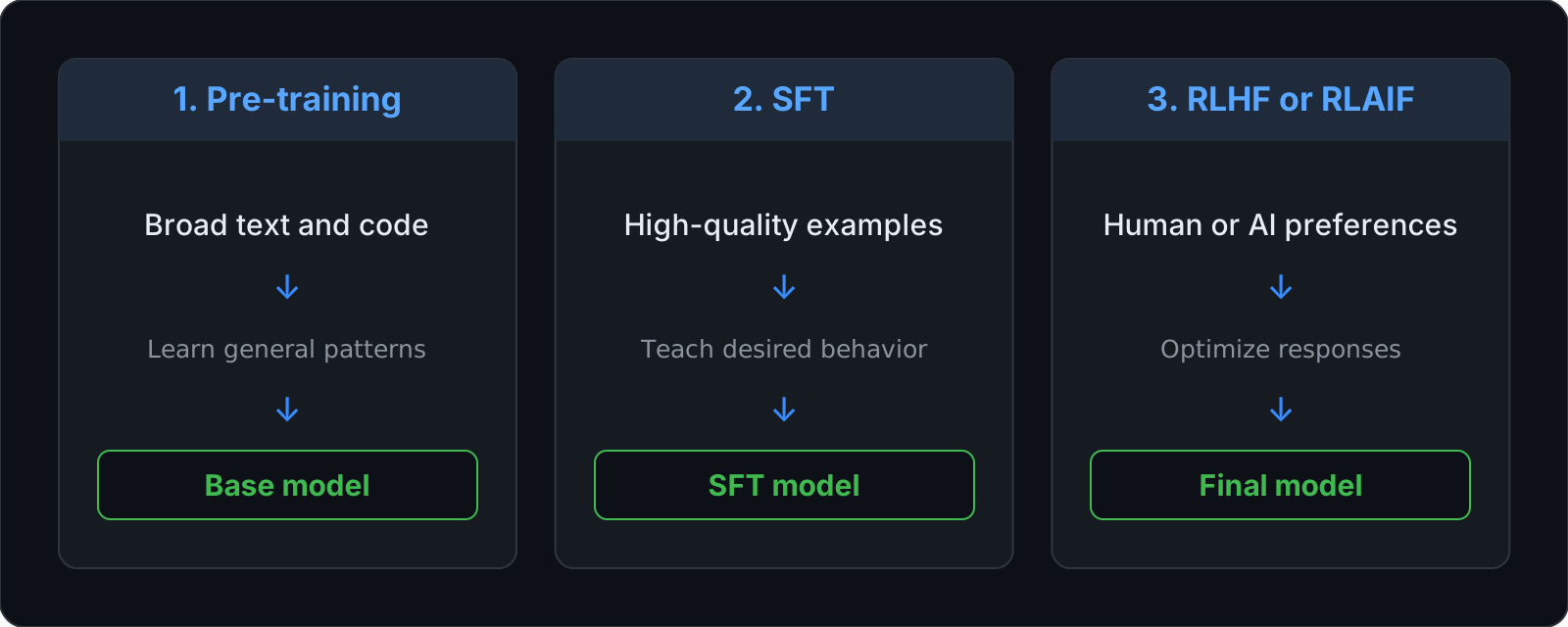
A simplified view of the three-stage training process.
- Pre-training: A base model processes a very large collection of text, code and other data, normally using self-supervised learning. This is where the model develops its broad ability to predict and work with language. This process is extremely expensive because of the time and scale of compute required.
- Supervised fine-tuning, or SFT: The base model is refined using smaller, higher-quality datasets that demonstrate the behavior we want. These examples can teach the model to follow instructions, write code, carry a conversation or perform work in a specific domain.
- Reinforcement learning from human feedback, or RLHF: People compare responses or classify their quality. Those preferences can be used to train a reward model and guide the system toward more useful and reliable behavior.
So what do we mean by RSI?
Recursive self-improvement is the idea that an AI system can evaluate and modify the processes that determine its own capabilities, then use the improved version to repeat the cycle without human intervention. Each iteration becomes the starting point for the next. If those improvements compound, AI development could move much faster than any research process that depends on humans at every step.
Even if full RSI requires autonomy, the path toward it is not all or nothing. AI is already helping researchers create the next generation of models. So the more useful question is: where does the loop still get stuck?
Faster iteration is not automatic
At this point it is tempting to imagine every model immediately building a better model. Current LLM development has a few hard constraints that make the picture more complicated.
First, pre-training takes enormous amounts of compute, time and money. A better research loop can help teams choose experiments or improve the systems around a training run, but the run still has a physical and commercial cost.
There is also a difference between producing more experiments and producing better results. If you have used a coding agent, you have probably seen it try several possible fixes before finding the right one. That approach is useful when each attempt is cheap. If an experiment requires a large training run, 99 unsuccessful ideas are still very expensive before the useful one appears.
This is where research taste becomes important. Research taste is the judgment to recognize which questions are worth asking and which experiment is likely to teach you something useful. Agents can search a large space of plausible ideas. Humans are still important in deciding which part of that space is worth paying to explore. Agents may develop stronger research taste over time, but brute-force exploration and good judgment are not the same thing.
Finally, a recursive loop can make a model worse. If models train repeatedly on their own outputs without enough high-quality external data or trustworthy evaluation, they can lose useful variation and reinforce their own mistakes. This is commonly discussed as model collapse.
Where could RSI become a game changer?
We already have enormous amounts of data. The harder problem is discovering a better way to turn that data and compute into a more capable model.
An AI-driven research process could optimize the architecture behind pre-training or create a new one entirely. It could explore different training methods and efficiency improvements, looking for ways to train models faster and at a lower cost. The more interesting possibility is an approach that researchers have not considered yet.
This is where RSI could become much more than an automation tool. If AI helps discover an architecture that trains faster, costs less or learns in a different way, it could change the speed of the entire improvement loop. That would be the future. And honestly, the thing I care most about is that we can still see what the loop is doing, and still tell faster from better.